Explainer
What is a field watch
Published
Short answer
A field watch is a simple, rugged, easy-to-read watch descended from the wristwatches issued to soldiers from World War I onward. It has a high-contrast dial with large numerals, often an inner 24-hour track, luminous hands, a modest case and a canvas or leather strap. It does without a rotating bezel, which keeps it light and slim.
Watches and gear for this
All 8 picks compared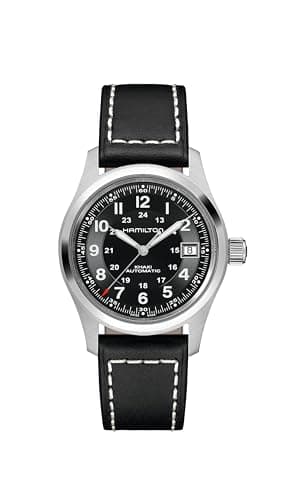
Hamilton Khaki Field Auto 38mm, 80 hours, sapphire
See price on AmazonSee it on Amazon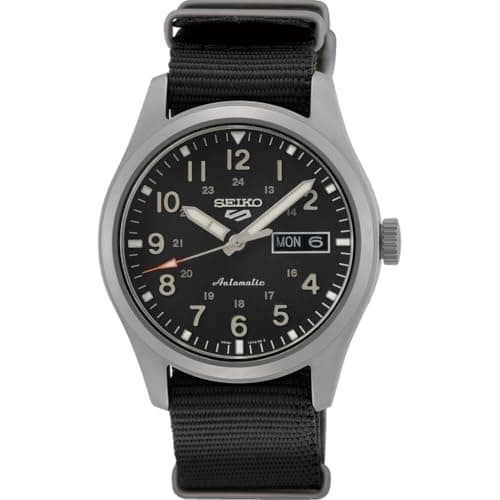
Seiko 5 Sports SRPG37, 39.4mm field, 4R36
See price on AmazonSee it on Amazon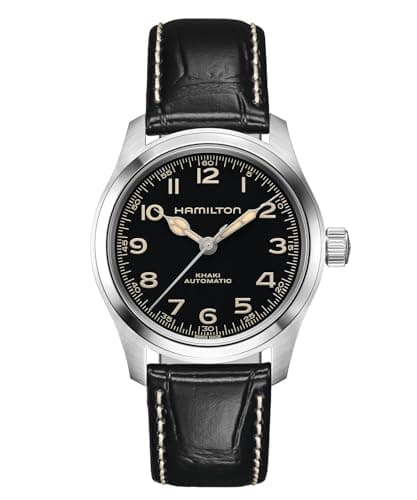
Hamilton Khaki Field Murph 38mm, 80 hours
See price on AmazonSee it on Amazon
Field watches are one of the classic watch styles, alongside the dive watch and the dress watch. This page explains where the style came from, the features that define it, why those features keep it readable, and what to look for when buying one. It is for anyone weighing a field watch as a first automatic or an everyday watch. For specific models, see our guide to the best automatic field watches.
Where field watches come from
Before World War I, most men carried pocket watches. In the trenches, soldiers needed both hands free and had to read the time quickly to coordinate attacks, so wristwatches spread fast. These early military wristwatches had large numerals, luminous paint and sturdy cases, and they set the pattern for the field watch.
Military watches of World War II and the decades after kept the same idea: legible, tough and cheap enough to issue in large numbers. Hamilton, which supplied watches to the US military, still describes its Khaki Field as rooted in watches designed for World War I soldiers. Many brands now make civilian versions of the style.
The features that define a field watch
Not every field watch has every feature, but most have the clear numerals and the simple, uncluttered layout.
- High-contrast dial. Usually black with white numerals, or white with black, so the time reads at a glance.
- Full Arabic numerals. Large 1 to 12 numerals rather than just markers.
- 24-hour track. A small inner ring of 13 to 24 lets you read military time without math.
- Lume. Luminous hands and numerals for reading at night. See watch lume explained.
- No rotating bezel. A plain fixed bezel keeps the case slim and the dial large for the size.
- Modest size. Classic field watches are 36 to 40 mm; modern versions go up to about 42 mm.
- Utility strap. Canvas, nylon or leather, easy to swap and comfortable in heat.
Why field watches stay readable
Every part of a field watch is chosen to make the time readable fast. The numerals are large and printed in a color that contrasts sharply with the dial. The hands are long enough to reach their tracks and wide enough to carry lume. There is no date window, chronograph or bezel scale competing for attention on many models.
This is also why field watches are easy to wear every day. They read well in sun and in a dark room, they suit casual clothes, and the slim case fits under a jacket cuff.
Field watch examples and specs
The table below shows common field watches with figures from current listings.
| Watch | Case | Movement | Power reserve | Water resistance |
|---|---|---|---|---|
| Hamilton Khaki Field Mechanical | 38 mm | H-50, hand wound | 80 hours | 50 m |
| Hamilton Khaki Field Mechanical | 42 mm | H-50, hand wound | 80 hours | 50 m |
| Hamilton Khaki Field Automatic | 42 mm | H-10, automatic | 80 hours | not in listing |
| Seiko 5 Sports SRPG37 | 39.4 mm | 4R36, automatic | about 41 hours | 10 bar (100 m) |
How to choose a field watch
- 1
Pick your movement type. Hand wound, like the Hamilton H-50, keeps the case thin and you wind it daily. Automatic winds itself. Compare them in Khaki Field mechanical vs automatic.
- 2
Choose the size. Classic field watches are 38 mm, which suits most wrists. See Khaki Field 38 mm vs 42 mm.
- 3
Check water resistance. Many field watches are 50 m, which is fine for rain and hand washing but limited for swimming. The Seiko 5 field models list 100 m.
- 4
Look at the crystal. Sapphire, as on the Hamilton listings, resists scratches better than mineral or Hardlex.
- 5
Choose a strap you will actually wear. Canvas and nylon are light and cheap to replace.
Field watch vs dive watch vs dress watch
The three classic styles overlap, but each is built around a different job. A field watch sits between the other two: tougher and more casual than a dress watch, slimmer and simpler than a diver. Many people pick a field watch as their one everyday watch for exactly that reason. Read what is a dress watch for the other end of the scale.
| Field watch | Dive watch | Dress watch | |
|---|---|---|---|
| Main job | Read the time fast, anywhere | Time dives, survive water | Look neat with formal clothes |
| Bezel | Fixed, plain | Rotating timing bezel | Thin, fixed |
| Dial | Large numerals, 24-hour track | Large lumed markers | Minimal markers |
| Typical strap | Canvas, nylon, leather | Bracelet, rubber | Leather |
| Case | Slim to medium | Thicker | Thinnest |
Frequently asked questions
Is a field watch good for everyday wear? Yes. It is one of the most versatile styles: easy to read, light, and suited to casual and smart casual clothes.
What is the difference between a field watch and a dive watch? A dive watch adds a rotating timing bezel, higher water resistance and often a thicker case. A field watch is simpler and slimmer. See dive watch vs field watch.
Why do field watches have 24-hour numbers? The inner 13 to 24 track lets you read military or 24-hour time directly, a habit carried over from the watches' military use.
What size should a field watch be? Traditional field watches are 36 to 40 mm. 38 mm is the classic size and suits most wrists; 42 mm suits larger wrists.