Comparison
Automatic vs quartz watches: what you actually give up
Published
Short answer
A quartz watch is more accurate, cheaper to own and keeps running in a drawer until the battery dies. An automatic watch winds itself from wrist motion, needs no battery, but drifts by seconds per day and needs periodic service. Pick quartz for set-and-forget accuracy and automatic if you value the mechanism and the sweeping seconds hand.
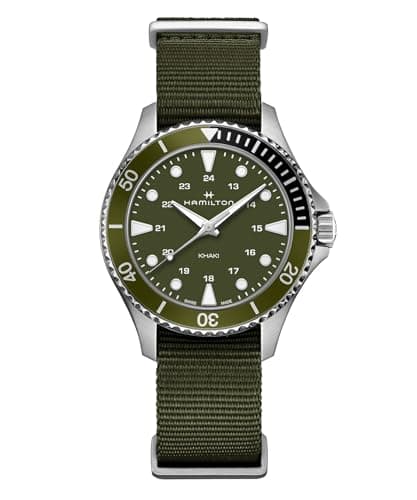
Hamilton
Hamilton Khaki Navy Scuba 37 mm: quartz, sapphire
See price on Amazon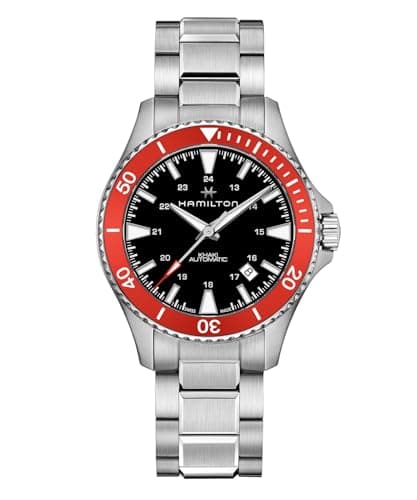
Hamilton
Hamilton Khaki Navy Scuba 40mm, 80-hour H-10
See price on Amazon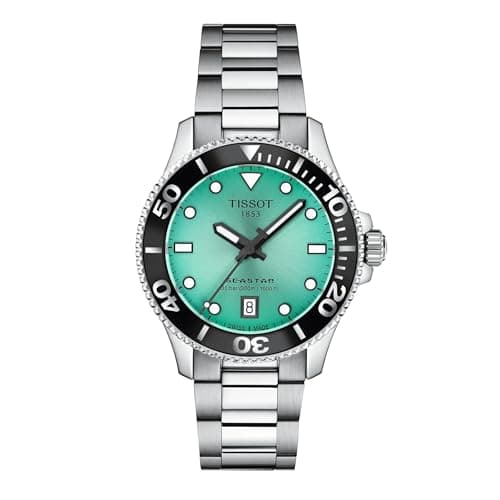
Tissot
Tissot Seastar 1000 36 mm: 9.67 mm thin quartz diver
See price on Amazon
- Hamilton Khaki Navy Scuba 37 mm: quartz, sapphire
- Case size
- 37 mm
- Thickness
- Not stated
- Movement
- Quartz
- Water resistance
- 100 m
- Hamilton Khaki Navy Scuba 40mm, 80-hour H-10
- Case size
- 40 mm
- Thickness
- -
- Movement
- Swiss H-10 automatic
- Water resistance
- 100 m
- Tissot Seastar 1000 36 mm: 9.67 mm thin quartz diver
- Case size
- 36 mm
- Thickness
- 9.67 mm
- Movement
- Swiss quartz
- Water resistance
- 300 m
| Pick | Case size | Thickness | Movement | Water resistance | Price | Link |
|---|---|---|---|---|---|---|
| Hamilton Khaki Navy Scuba 37 mm: quartz, sapphire | 37 mm | Not stated | Quartz | 100 m | - | Amazon |
| Hamilton Khaki Navy Scuba 40mm, 80-hour H-10 | 40 mm | - | Swiss H-10 automatic | 100 m | - | Amazon |
| Tissot Seastar 1000 36 mm: 9.67 mm thin quartz diver | 36 mm | 9.67 mm | Swiss quartz | 300 m | - | Amazon |
Facts are taken from each Amazon listing. Prices are checked daily and shown with their date.
Verdict
Buy the Hamilton Khaki Navy Scuba Quartz or the Tissot Seastar 1000 Quartz if you want accuracy and low upkeep. Buy the Scuba Automatic if you want a battery-free mechanical watch and accept daily drift and periodic service; its listed 80-hour reserve makes it easy to live with.
This page is for anyone choosing between a battery-powered quartz watch and a self-winding automatic, often the same model offered both ways. We cover accuracy, what happens when you take the watch off, battery changes versus full services, and what the price gap buys. To keep it concrete, we compare the Hamilton Khaki Navy Scuba in quartz and automatic form, plus a Tissot Seastar 1000 quartz, using only what their listings state.
How each movement keeps time
A quartz movement uses a battery to send current through a small quartz crystal, which vibrates at a very stable frequency. A circuit counts those vibrations and steps the seconds hand once per second. Because the crystal is so stable, quartz watches are accurate with very little effort from the owner.
An automatic movement is fully mechanical. A rotor spins as your wrist moves and winds a mainspring. The spring releases energy through a gear train to a balance wheel that swings back and forth several times per second, which is why the seconds hand sweeps instead of ticking. Our automatic watch explainer walks through each part.
- Wrist motionYour arm moves.
- RotorA half-moon weight spins on its axle.
- Reversing wheelsTurn both swing directions into winding.
- Mainspring barrelStores the energy as a coiled spring.
- Gear trainCarries the power to the hands.
- Escape wheelReleased one tooth at a time.
- Pallet forkLocks and unlocks the escape wheel.
- Balance wheelSwings back and forth at a steady rate.
Spec table: the same diver in quartz and automatic
The Hamilton Khaki Navy Scuba is listed in both quartz and automatic versions, which makes it a fair test of what the movement choice changes. All figures below come from the Amazon listings. Where a listing does not state something, the table says so.
| Model | Movement | Case | Water resistance | Crystal | Listed price |
|---|---|---|---|---|---|
| Hamilton Khaki Navy Scuba Quartz | Quartz, listed at about one minute deviation per year | 37 mm steel | 100 m | Sapphire | $645 |
| Hamilton Khaki Navy Scuba Automatic | Swiss H-10 automatic, 80-hour reserve | 40 mm steel | 100 m | Sapphire | $975 |
| Tissot Seastar 1000 Quartz (36 mm) | Swiss quartz, hour, minute, second, date | 36 mm steel, 9.67 mm thick | 300 m | Sapphire | $495 |
Note.The automatic Scuba listing does not state a daily accuracy figure, and the quartz Scuba listing does not state case thickness. Check the maker's spec sheet if those matter to you.
Accuracy: seconds per year versus seconds per day
This is the clearest gap. The Hamilton quartz listing claims deviation of about one minute per year. A mechanical watch is normally measured in seconds per day, and even a well-regulated automatic will drift more than a typical quartz over a month. If you want a watch you set once and rarely touch, quartz wins.
That does not make automatics inaccurate in daily life. Most owners reset the time every week or two, often when the date needs changing anyway. Our guide on how accurate an automatic should be explains normal ranges and when drift points to a problem, and running fast covers the common cause, magnetism.
Taking it off: power reserve versus battery life
A quartz watch keeps running in a drawer until the battery runs out, which is usually a matter of years. An automatic only runs as long as its power reserve. The Scuba Automatic lists an 80-hour reserve, so it can sit from Friday evening to Monday morning and still be running. Many cheaper automatics list closer to 40 hours, which means they stop overnight after a day off the wrist.
If you rotate several watches, an automatic will often need resetting when you pick it up. That is normal, not a fault. See power reserve explained and how to start a stopped automatic. A watch winder is optional, not required.
Cost of ownership and service intervals
Quartz upkeep is mostly battery changes. On a water-resistant watch such as a diver, have the battery changed by a shop that can replace the gaskets and pressure test the case, because opening the caseback can affect water resistance.
An automatic has no battery but has moving parts running in oil. Over time the oils age and parts wear, so mechanical watches need a full service at intervals that vary by brand and use. A service costs much more than a battery change. Our service interval guide covers the signs that a service is due. Upfront price also differs: the automatic Scuba lists at $975 against $645 for the quartz.
- Quartz: lower upfront price in the same family, battery swaps, very little drift.
- Automatic: higher upfront price, no battery, periodic full service, seconds-per-day drift.
- Both: water-resistant cases should be pressure tested after the back is opened.
What an automatic gives you instead
People buy automatics for the mechanism itself: no battery, a smoothly sweeping seconds hand, and a movement that can be serviced and kept running for decades. Many automatics also show the movement through a display caseback. If those things matter to you, the accuracy and service trade-offs are part of the deal. Our article on whether automatics are worth it goes further, and if you want a battery-free option with quartz accuracy, read automatic vs kinetic vs solar.
Ready to shop? Start with our picks of automatic watches under $1,000 or the more affordable under $500 list.
Frequently asked questions
Is an automatic watch more accurate than quartz? No. Quartz is more accurate. The Hamilton Scuba Quartz listing claims about one minute per year, while mechanical watches are measured in seconds per day.
Does an automatic watch need a battery? No. It is wound by a rotor that turns with wrist motion, and most can also be wound by the crown. It stops when the power reserve runs out.
Is a quartz watch cheaper to own? Usually. A battery change costs far less than a full mechanical service, though water-resistant cases should still be resealed and tested.
Can I leave an automatic in a drawer? Yes. It will simply stop when the reserve runs down. Wind it and set the time when you pick it up again.